ANT 206 · World Pre-History · Final Project
Olmec Art and Its Legacy in Mesoamerica
How did the iconographic conventions of the Olmec civilization persist in and shape the visual cultures of the Maya, centuries after the Gulf Coast heartland cities fell silent?
Introduction
The Olmec have long been regarded as the "mother culture" of Mesoamerica, with their cultural roots present across the civilizations that followed them across Central America. While this claim can be disputed by the various cultures independently present across Mesoamerica, the Olmec introduced a strong visual language that was reproduced across regions and centuries. As Blomster, Neff, and Glascock demonstrated through chemical analysis of exported ceramics, the Olmec were responsible for "the first unified style and iconographic system in Mesoamerica" (2005, 1068). This is not just a claim about artistic precedence, but serves as an argument about the deliberate construction of a visual language strong enough to span centuries.
It is easy to misconstrue this as a story of one culture copying another, but there is deeper symbolism present. These objects served not as decoration but as expressions of political authority. Thes objects served as claims about supernatural power and the legitimacy of rulers for following cultures. The were-jaguar motif and the tradition of monumental stone portraiture persisted not simply through admiration, but because successor cultures actively adopted these symbols into their own system. As Blomster et al. put it, rather than being imposed, these symbols "were received by people, probably leaders, at regional centers, who used, manipulated, and reproduced them in different ways" (2005, 1071). Alike to many ancient civilizations, these objects served as tools of legitimacy for rulers.
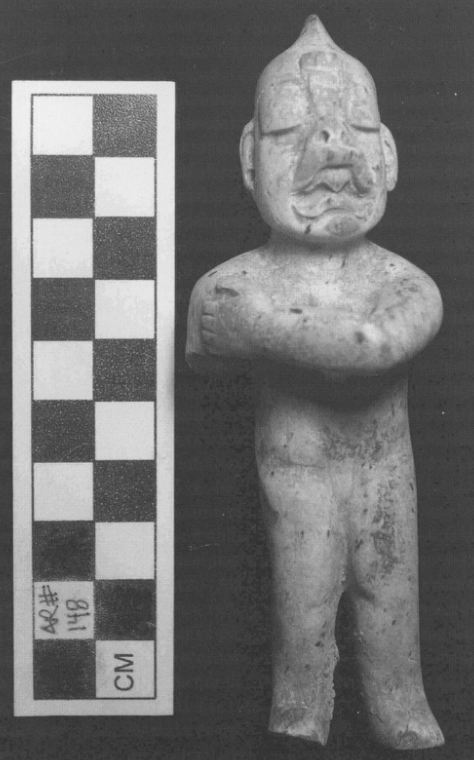
While it might seem difficult to fingerprint iconography across the history and geography of Mesoamerica, there are cases where identified Olmec artifacts have been found preserved by following civilizations. A greenstone figurine discovered in a Late Classic Maya royal tomb at El Perú-Waka', Guatemala, dating to around 600–650 CE, bore "iconographic characteristics associated with the Olmec Maize God" and showed signs of long use before burial, its "worn condition suggest[ing] long, perhaps continuous, use" (Rich et al. 2010, 115, 117). It is not a replica but an actual Olmec object, preserved across centuries, placed intentionally in a Mayan king's tomb. That is the kind of evidence this project observes to answer how Olmec iconography persisted across millennia and geography.
Research Question
How did Olmec iconographic conventions, specifically the were-jaguar motif and monumental portraiture, persist in and shape the artistic traditions of the Maya?
How This Project Is Organized
The following pages work through the question in the order: background to evidence to synthesis.
-
Scholarly Background
What scholars have established about Olmec iconography: how art functioned as political technology, the were-jaguar as a coherent supernatural cluster, and the ongoing debate about how Olmec influence actually worked.
-
Investigation
The evidence: tracing were-jaguar attributes from La Venta's altars to non-heartland sites across Mesoamerica, and Olmec monumental portraiture into the Maya narrative tradition.
-
Conclusion & References
What the evidence shows, what remains genuinely uncertain, and the full reference list.