Page 4 of 4
Conclusion
What the evidence shows, what remains genuinely uncertain, and the full reference list.
What the Evidence Shows
This project set out to investigate how Olmec iconographic conventions, specifically the were-jaguar motif and monumental portraiture, persisted in and shaped the artistic traditions of the Maya. The evidence, drawn from excavation reports, scholarly catalogs, chemical analysis, and field excavation of a Late Classic Maya tomb, produces a clear picture.
The approach that matters most is the one Blomster, Neff, and Glascock identify: these symbols "were received by people, probably leaders, at regional centers, who used, manipulated, and reproduced them in different ways" (2005, 1071). This is not a story of one culture copying another or of a civilization forcing its imagery outward. It is a story of elites across Mesoamerica actively choosing to adopt a visual language that carried sybmols of supernatural authority and political legitimacy because it was useful to them. Olmec iconography persisted because people wanted it to, and because what it communicated was still valuable a millennium after the Olmec civilization had declined.
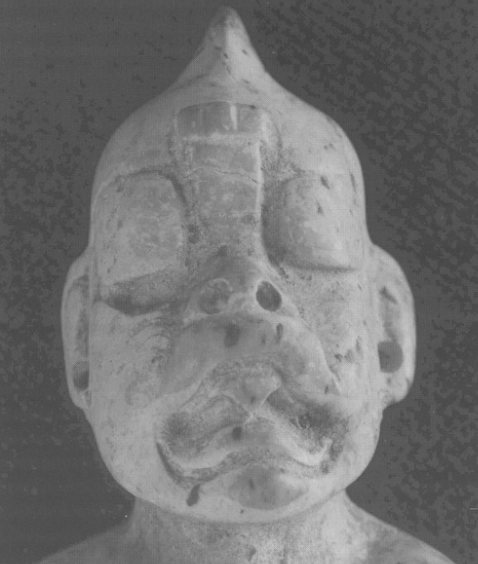
The Burial 39 figurine from El Perú-Waka', Guatemala, is the single piece of evidence that brings the whole argument together. Rich et al. document its discovery in a Late Classic Maya royal tomb, worn from centuries of use, bearing were-jaguar and Maize God iconographic attributes identical to Formative-period Olmec objects produced more than a thousand years earlier. They conclude that it was "an heirloom object that may have been curated for centuries," and that its discovery "strengthens the trend in evidence affirming the continuity in the cult of the maize god as well as divine kingship spanning Olmec and lowland Maya civilizations" (Rich et al. 2010, 120). A Maya king was buried with a worn Olmec object he or his predecessors had kept, used, and valued.
What Remains Open
Two things remain genuinely uncertain. The first is the label. The animal component of the "were-jaguar" is still contested in the literature, whether the composite figure draws primarily on jaguar, caiman, or some combination of animals is an open scholarly question. What is not uncertain is the formal vocabulary itself. The V-cleft, skull, the flame brows, the downturned fanged mouth,are specific, reproducible, and traceable regardless of what we call the creature.
The second is the scope of the mother culture argument. I came away from this research more skeptical of "mother culture" as a framework than I started. The evidence better supports a regional network than a single-origin. The Olmec were genuine innovators, Blomster et al. are clear that they created "the first unified style and iconographic system in Mesoamerica" (2005, 1068), but that innovation spread through demand, adoption, and elite exchange, not domination. That is a more interesting story, and I think a more accurate one.
Final Reflection
What surprised me most in this research was how physical the evidence is. Going in, I expected to be making arguments about stylistic resemblance between cultures. Instead I found a 1943 field report documenting a jaguar carving at the same non-heartland site where a 2005 chemical study confirmed Olmec pottery with were-jaguar imagery. Two completely independent sources converging on the same location. I found a figurine in a Maya king's tomb still carrying the attributes of a culture that had been gone for over a thousand years. The Olmec visual language was durable not because it was only beautiful, but because it meant something specific and powerful that successive generations of rulers understood and chose to claim.
References
Primary Sources
- La Venta Monument 11 (Seated Were-Jaguar Figure with Upturned Head). Basalt, Formative Period. La Venta, Tabasco, Mexico. Museo Regional de Antropología, Villahermosa. Catalog entry in Benson and de la Fuente 1996, pp. 164–165.
- San Lorenzo Monument 6, Colossal Head 8. Basalt, Early Preclassic Period. San Lorenzo, Veracruz, Mexico. Museo de Antropología de Tabasco, Universidad Veracruzana. Illustrated in Clark and Pye 2000, pp. 54–55.
Secondary Sources
- Benson, Elizabeth P. and Beatriz de la Fuente, eds. Olmec Art of Ancient Mexico. Washington, D.C.: National Gallery of Art, 1996.
- Blomster, Jeffrey P., Hector Neff, and Michael D. Glascock. "Olmec Pottery Production and Export in Ancient Mexico Determined through Elemental Analysis." Science 307, no. 5712 (18 February 2005): 1068–1072. https://doi.org/10.1126/science.1107599
- Clark, John E. and Mark E. Pye, eds. Olmec Art and Archaeology in Mesoamerica. Studies in the History of Art 58. Washington, D.C.: National Gallery of Art, 2000.
- Rich, Michelle, David Freidel, F. Kent Reilly III, and Keith Eppich. "An Olmec Style Figurine from El Perú-Waka', Petén, Guatemala: A Preliminary Report." Mexicon 32, no. 5 (Oktober 2010): 115–122. https://www.jstor.org/stable/23758890
- Stirling, Matthew W. Stone Monuments of Southern Mexico. Bureau of American Ethnology Bulletin 138. Washington, D.C.: U.S. Government Printing Office, 1943. archive.org
Image Sources
- La Venta Monument 11 (front and back); Las Limas Monument 1; Tenochtitlan Monument 1; La Venta Stelae 2 and 3; El Animal, Chalcatzingo; Laguna de los Cerros monument. Photographed from: Benson, Elizabeth P. and Beatriz de la Fuente, eds. Olmec Art of Ancient Mexico. Washington, D.C.: National Gallery of Art, 1996.
- San Lorenzo Monument 6, Colossal Head 8 (close-up and full views). Photographed from: Clark, John E. and Mark E. Pye, eds. Olmec Art and Archaeology in Mesoamerica. Washington, D.C.: National Gallery of Art, 2000.
- Burial 39 figurine (frontal, face detail, in situ). Rich, Michelle, David Freidel, F. Kent Reilly III, and Keith Eppich. "An Olmec Style Figurine from El Perú-Waka'." Mexicon 32, no. 5 (2010). Photo credits: Michelle Rich (Figs. 3, 4, 5); Erin Sears (Figs. 6, 7).
Claude (Anthropic) was used in the preparation of this project in the following permitted ways: organizing and cross-referencing extracted source notes from physical books and PDFs; renaming and cataloging image files; drafting an outline mapping sources to the four-page website structure; checking citation formatting; and searching for public-domain images. All written analysis, scholarly interpretation, and final text on this website is my own. The thesis, research question, and argument were developed through my own reading of physical books and journal articles. AI was not used to write content or generate visuals.