Page 3 of 4
Investigation
Tracing the were-jaguar motif and monumental portraiture from the Olmec heartland into the Maya world through physical objects, field documentation, and chemical evidence.
With the background established, I want to look at the specific evidence for how Olmec iconography traveled and persisted. This investigation is organized into three sections. The first examines the were-jaguar in its heartland context, what it looked like and what it meant at La Venta. The second traces it to sites outside the Gulf Coast heartland, where the evidence becomes particularly compelling. The third examines the tradition of monumental stone portraiture and what happened to it in the Maya world.
Section A: The Were-Jaguar at the Source
The were-jaguar motif appears most densely at the two major Olmec centers; San Lorenzo (c. 1500–900 BCE) and La Venta (c. 900–400 BCE) and its formal attributes are highly consistent across object and scale. The catalog entry for La Venta Monument 11 in Benson and de la Fuente 1996 gives perhaps the clearest physical description of the full were-jaguar form: "This hybrid combines human and fantastic features with those of animals to create a supernatural character. The seated body leans forward, its rigid arms extended over the bent legs with their clawlike feet; all elements are reduced to essential forms... a pair of fangs emerges from the thick lips. The nose is wide and flat; the ears are elongated and thin. Above the eyes, flame forms are depicted in place of eyebrows. The forehead merges with the headdress, giving the impression of an extended head with a V-shaped cleft terminating the center part" (p. 165).
That list of attributes; the V-cleft, the flame brows, the fangs, the clawlike features, is exactly what makes this iconography traceable. A vague stylistic resemblance between cultures doesn't produce this kind of formal specificity. A deliberately maintained and reproduced iconographic program does.
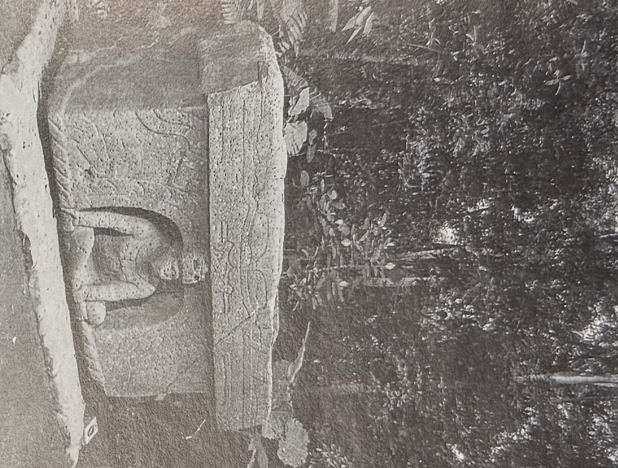
What I found most significant in the primary excavation record is not just what the were-jaguar looked like, but how Olmec rulers used it. Matthew Stirling's 1943 field report on La Venta documents Altar 4, which he describes as showing "a human figure in full relief seated cross-legged in a deep arched niche" with the niche itself identified as the open mouth of a jaguar, specifically, he called it the "'Olmec' open-jaguar-mouth motive since the designs on the band over the niche represent eyes" (Stirling 1943, 54). Altar 5 repeats this composition, adding a detail that changes how I read the whole tradition: "on his lap he holds the limp figure of a baby" (Stirling 1943, 55). This is not decoration, but a clear display of ritual or political power by a ruler. The same composition appears on multiple altars at the same site, which tells me this was a deliberate, repeated symbolic action.
Section B: Outside the Heartland
The argument that Olmec iconography traveled depends on finding it outside the Gulf Coast heartland. That evidence exists at multiple levels of confidence. De la Fuente names sites directly. Her essay documents Olmec creation myth imagery at Chalcatzingo (Morelos, central Mexican highlands) and Laguna de los Cerros (Veracruz), citing them as examples of "myths of creation, possession of the Earth by fertilizing gods such as Monument 1 of Chalcatzingo" and "humans emerging from the cave of Earth in a clear origin myth of Olmec peoples, as seen in Monument 3 of Laguna de los Cerros" (de la Fuente, in Benson and de la Fuente 1996, 314). Chalcatzingo is in the Mexican highlands and the carving there depicts the same cave/earth portal composition that Stirling documented at La Venta. Its presence there is evidence that the iconography was not confined to the Gulf Coast.
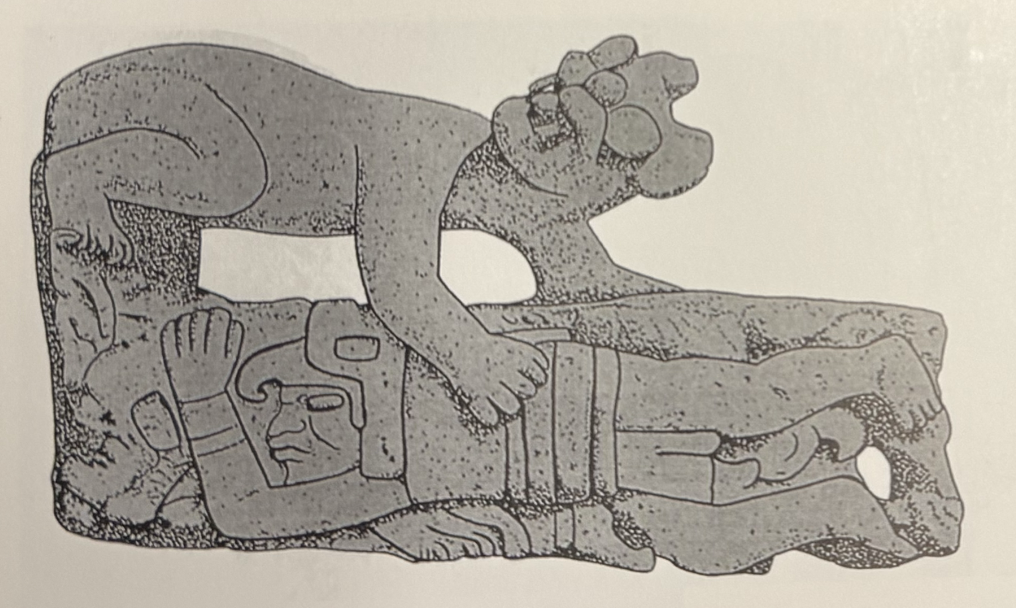
The most compelling piece of evidence I found is a convergence at Tlapacoya in the Valley of Mexico, where two independent sources, from entirely different research contexts, six decades apart, point to the same conclusion. Stirling's 1943 field report documents a stone jaguar at Tlapacoya: "From the nearby village of Tlapacoya Arriba, at the foot of Tuxtla Mountain, came one day a native carrying on his saddle the not inconsiderable burden of a stone jaguar. The head and forequarters are quite well carved" (Stirling 1943, 26). Then in 2005, Blomster, Neff, and Glascock's chemical fingerprinting study independently confirms that Tlapacoya received San Lorenzo-manufactured pottery bearing "elaborate profile views of cleft-headed creatures, Olmec-style designs occur on gray pottery with both San Lorenzo and local origins" (Blomster, Neff, and Glascock 2005, 1071). Stirling found a jaguar carving there. Blomster found chemically confirmed Olmec pottery with were-jaguar imagery there. Neither study was looking for the other. That convergence, for me, is the strongest single piece of evidence in this project that Olmec iconography physically reached non-heartland territory.
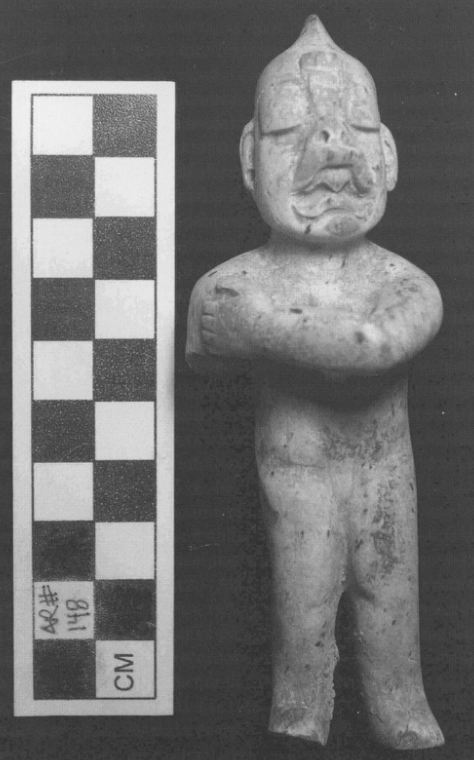
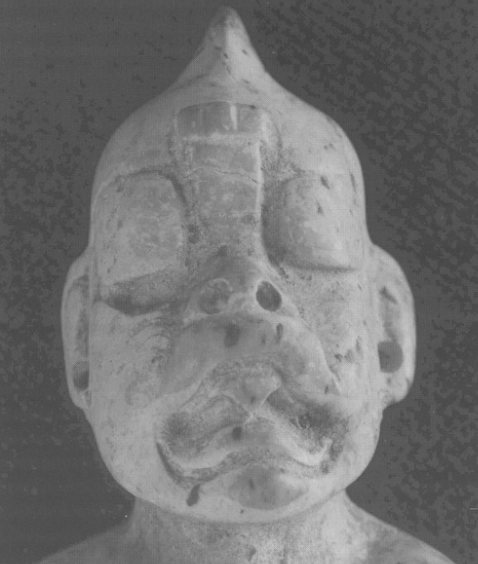
The endpoint of this argument is the Burial 39 figurine from El Perú-Waka', Guatemala. Excavated from a Late Classic Maya royal tomb dating to approximately 600–650 CE, the figurine had "iconographic characteristics associated with the Olmec Maize God... as well as others associated with the Olmec Rain God" and its "worn condition suggests long, perhaps continuous, use" (Rich et al. 2010, 115, 117). Rich and her co-authors describe its face as bearing "a were-jaguar stylized mouth with a protruding shark tooth, a trefoil diadem between the celtiform eyelids" (Rich et al. 2010, 118). This object was not a Maya copy of an Olmec style, but the wear indicates it was an actual Olmec-period object that had been kept, used, and eventually placed with a ruler as a burial offering more than a thousand years after the Olmec civilization had declined. Rich et al. conclude that the figurine's "enduring symbolism... coupled with the evident wear, likely mark it as an heirloom object that may have been curated for centuries" (Rich et al. 2010, 120). That is a remarkable statement. A Mayan king was buried with an Olmec heirloom. The iconography did not just travel from its origin, but it was deliberately preserved.
Section C: Monumental Portraiture and the Bridge to Maya Art
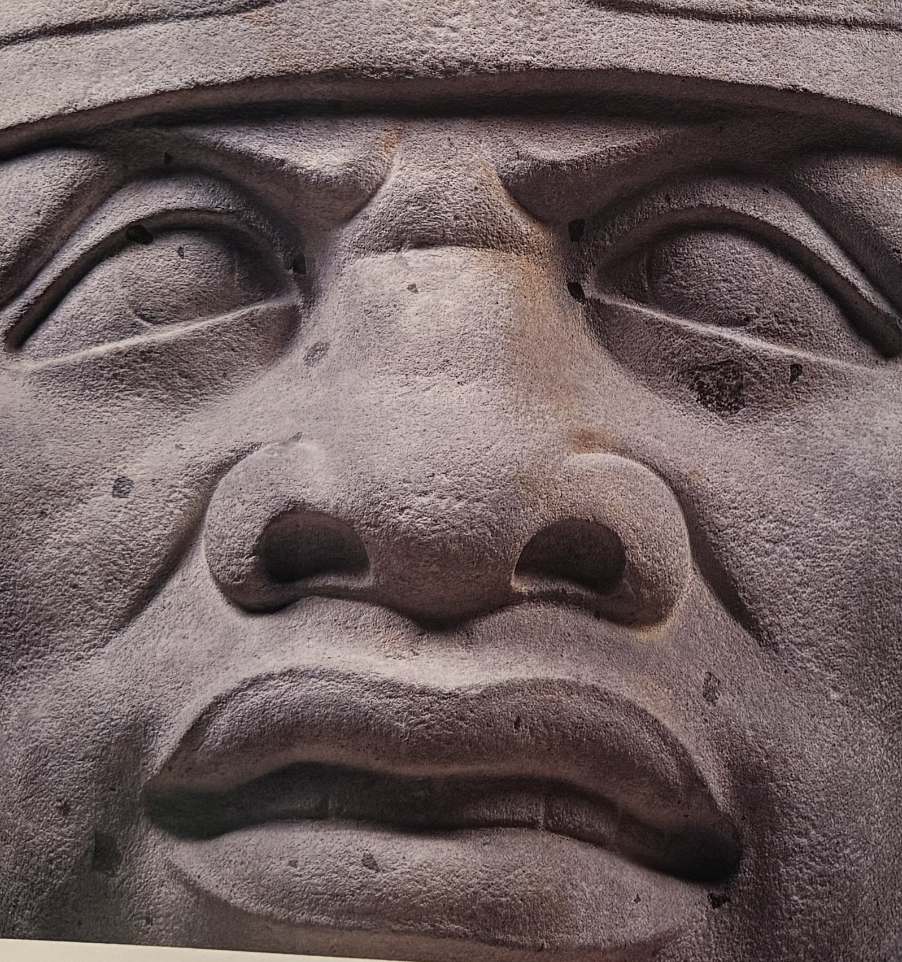
Alongside the were-jaguar, the Olmec developed the earliest portrait tradition in the Americas; the colossal heads. De la Fuente's essay documents the scale of this tradition, "The group of monuments of principal importance is constituted by images whose characteristics are exclusively human... I refer to the portraits of kings in the seventeen colossal heads: ten from San Lorenzo, four from La Venta, and three from Tres Zapotes and its environs" (de la Fuente, in Benson and de la Fuente 1996, 315). Clark and Pye's 2000 volume provides the same count independently: "To date, seventeen colossal heads are known. Ten come from San Lorenzo, four from La Venta, two from Tres Zapotes (also called Veracruz), and one from Rancho de La Cobata" (Clark and Pye 2000, 54–55).
Seventeen heads, across three distinct sites, all depicting rulers with individual stylistic features. This can be seen as an Olmec tradition of clarifying political authority at monumental scale in stone. The question is what happened to that tradition when the Olmec centers declined.
De la Fuente provides what I consider the strongest quote in my research for answering that question. Discussing the evolution of La Venta's monuments, she writes, "Over time, the La Venta style displayed an increase of geometrism and synthetic forms; plastic movement produced by the release of volume into space, and a wider discourse of scenic narrative. It seems to me that the final expressions of the La Venta style, the narrative slabs such as Stelae 2 and 3, were a sort of bridge between mythical and historical narratives such as seen in Maya times" (de la Fuente, in Benson and de la Fuente 1996, 257).
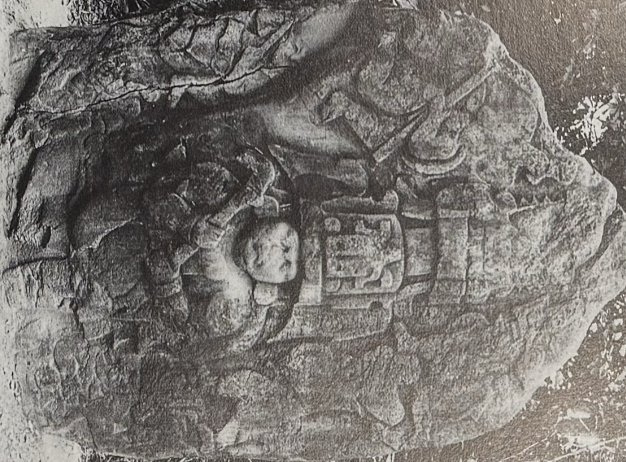
She is not making a vague analogy. She is saying that La Venta's late stelae, specifically Stela 2 and Stela 3, represent a shift from symbolic to narrative composition that anticipates the style of Classic Maya monuments. The carved stelae of the great Maya cities, which depict named rulers with detailed regalia and hieroglyphic historical records, are the direct descendants of this narrative tradition. This is a strong scholarly basis for the transmission argument, and it is grounded in the formal properties of the objects themselves.