Page 2 of 4
Scholarly Background
What researchers have established about Olmec iconography: its function, its geographic reach, and the debate about how it moved.
Art as Political Symbolism
A common assumption about ancient art is that its context is purely aesthetic or religious. These objects were made to be beautiful or to honor gods. Olmec art challenges that assumption. Scholars who have examined Olmec artifacts closely argue that these objects served as expressions of political power just as much as supernatural belief. Beatriz de la Fuente, one of the leading authorities on Olmec monumental sculpture, states this directly: "Art is the fundamental expression of underlying concepts: religious, political, social, technological or economic" (de la Fuente, in Benson and de la Fuente 1996, 314).
This framing matters for understanding why Olmec iconography persisted in later cultures. If these objects were primarily decorative, there would be little reason for Maya rulers centuries later to deliberately adopt and preserve them. But if they encoded claims about supernatural authority and political legitimacy (as de la Fuente argues), then their adoption by successor elites makes immediate sense. These were symbols of power, and that idea was inherited.
The Were-Jaguar: A Family of Supernaturals
The term "were-jaguar" is commonly used as shorthand for a repeating creature, but scholarship shows it is better understood as a cluster of related supernatural figures united by a consistent set of formal attributes. De la Fuente describes this family as follows: "Another cluster of thematically related monuments is constituted by figures that incorporate features of animals into their essential human aspects and others that are merely combinations of fantastic and visual characters... the jaguar, the were-jaguar, the humanized jaguar, and the baby jaguar. Certainly these images were related to mythical beings; they themselves were part or symbols of the myth" (de la Fuente, in Benson and de la Fuente 1996, 315).
What unites these figures across objects and sites is a reproducible set of physical attributes: a cleft or V-shaped indentation at the top of the skull, a dramatically downturned mouth with fleshy lips and emerging fangs, flame-shaped elements above the eyes, and almond-shaped heavy lids. These features appear with enough consistency across media, scale, and sites to indicate an intentional iconographic tradition rather than coincidental variation. The catalog entry for La Venta Monument 11 in Benson and de la Fuente 1996 captures these attributes precisely: "a pair of fangs emerges from the thick lips... flame forms are depicted in place of eyebrows. The forehead merges with the headdress, giving the impression of an extended head with a V-shaped cleft terminating the center part" (p. 165).
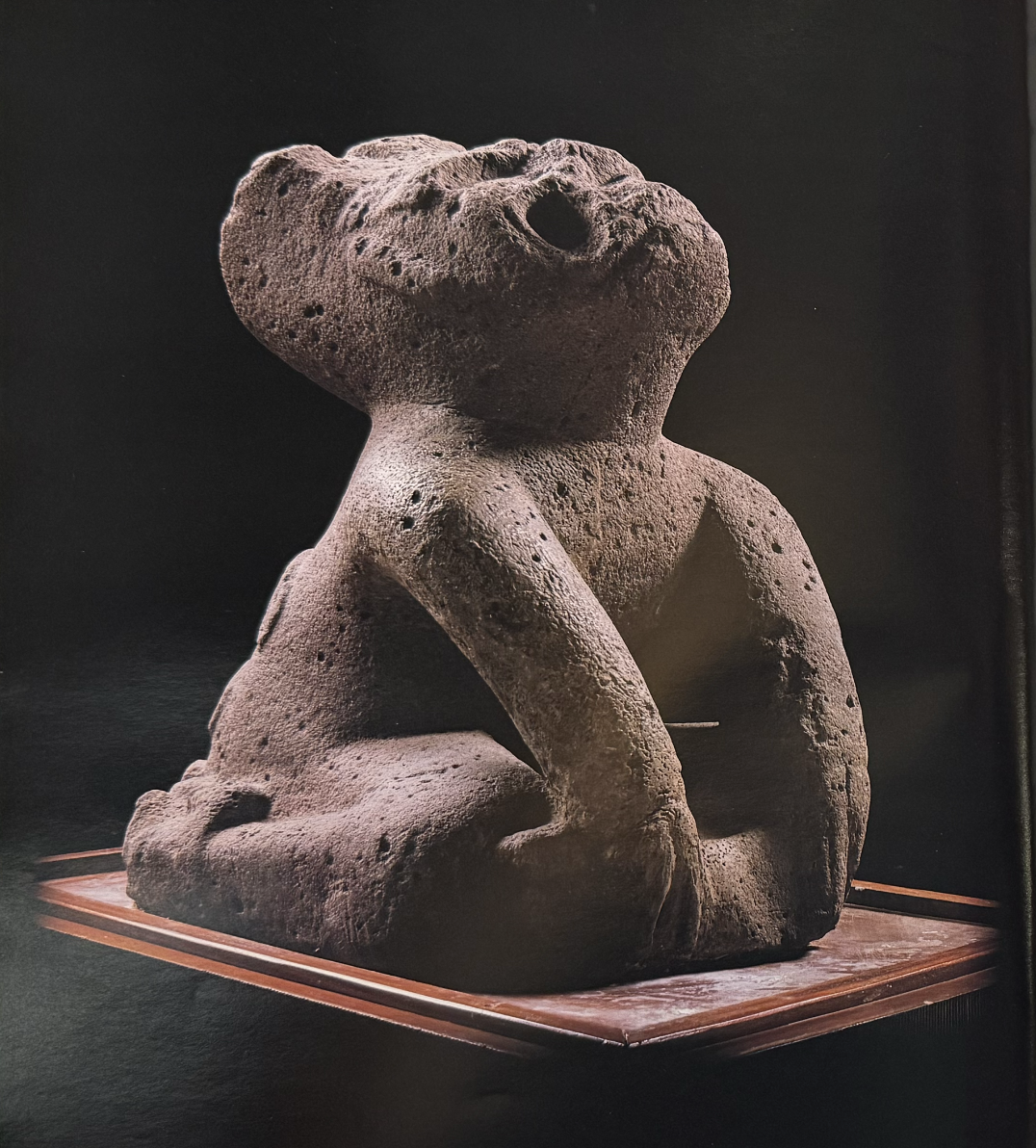
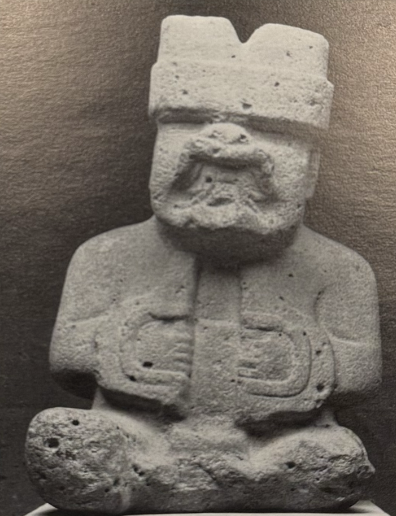
It is worth noting that the identification of the animal component of this figure remains debated among scholars. Some have argued that the features attributed to a jaguar are better explained by crocodilian anatomy, given the upturned snout and bony brow ridging visible on caimans. The debate has not been resolved, but for the purposes of tracing the motif, the animal label matters less than the formal attributes themselves. Whatever the creature is, its iconographic symbolism is specific and reproducible enough to track across space and time.
Geographic Reach: Beyond the Heartland
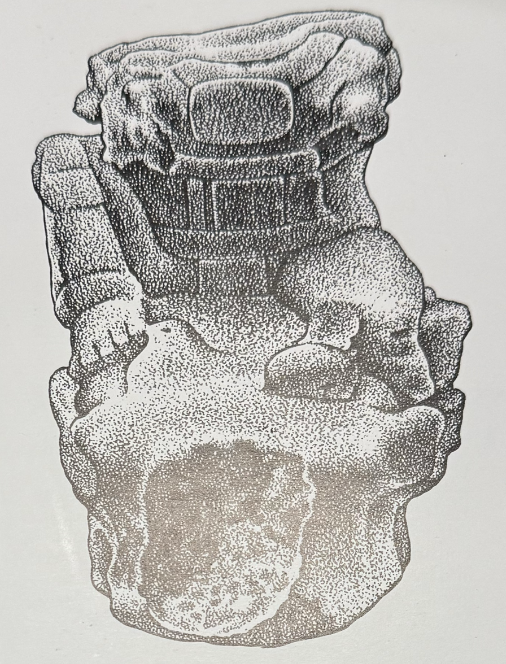
De la Fuente establishes early in her essay that Olmec iconographic traits were not confined to the Gulf Coast heartland. "Mesoamerica's first true art was created by the archaeological culture now known as the Olmec... What is important here is the recognition that these Olmec traits can be found in objects in distant regions, especially dating to the Middle Formative period" (de la Fuente, in Benson and de la Fuente 1996, 313). She goes further in the same essay to specify the geographic range: "Nowadays Olmec traits are known to occur in a much wider region than the Gulf Coast and Mexican highlands. Olmec style objects occur in the Mexican states of Guerrero and Chiapas, Guatemala, and portions of lower Central America" (p. 314).
This was a striking claim to me. Guerrero is on the Pacific coast of western Mexico,far removed from the Gulf Coast. Chiapas and Guatemala place Olmec iconographic influence at the edge of the later Maya civilization. The investigation pages will trace how this geographic spread happened and what the physical evidence looks like.
The Mother Culture Debate: Influence vs. Gradual Evolution
The idea that the Olmec were the "mother culture" of Mesoamerica, a single point of origin for all subsequent civilizations, is appealing in its simplicity but is, I think, an overgeneralization of a much more gradual and regional process. The Olmec did not force their visual language top-down across Mesoamerica. What the evidence better supports is a network in which symbols moved through elite exchange and deliberate adoption by neighboring rulers.
Blomster, Neff, and Glascock's chemical identification study of Olmec ceramics makes this dynamic explicit. Their analysis traces exported pottery from San Lorenzo to sites across Mesoamerica and concludes that "rather than being imposed by the Olmec, these symbols were received by people, probably leaders, at regional centers, who used, manipulated, and reproduced them in different ways" (Blomster, Neff, and Glascock 2005, 1071). The key word is "received." Regional elites chose to adopt Olmec iconography because it was politically useful to them, not because Olmec rulers forced it on them. This distinction matters as it means the persistence of Olmec iconography across centuries reflects active demand, not passive inheritance.